





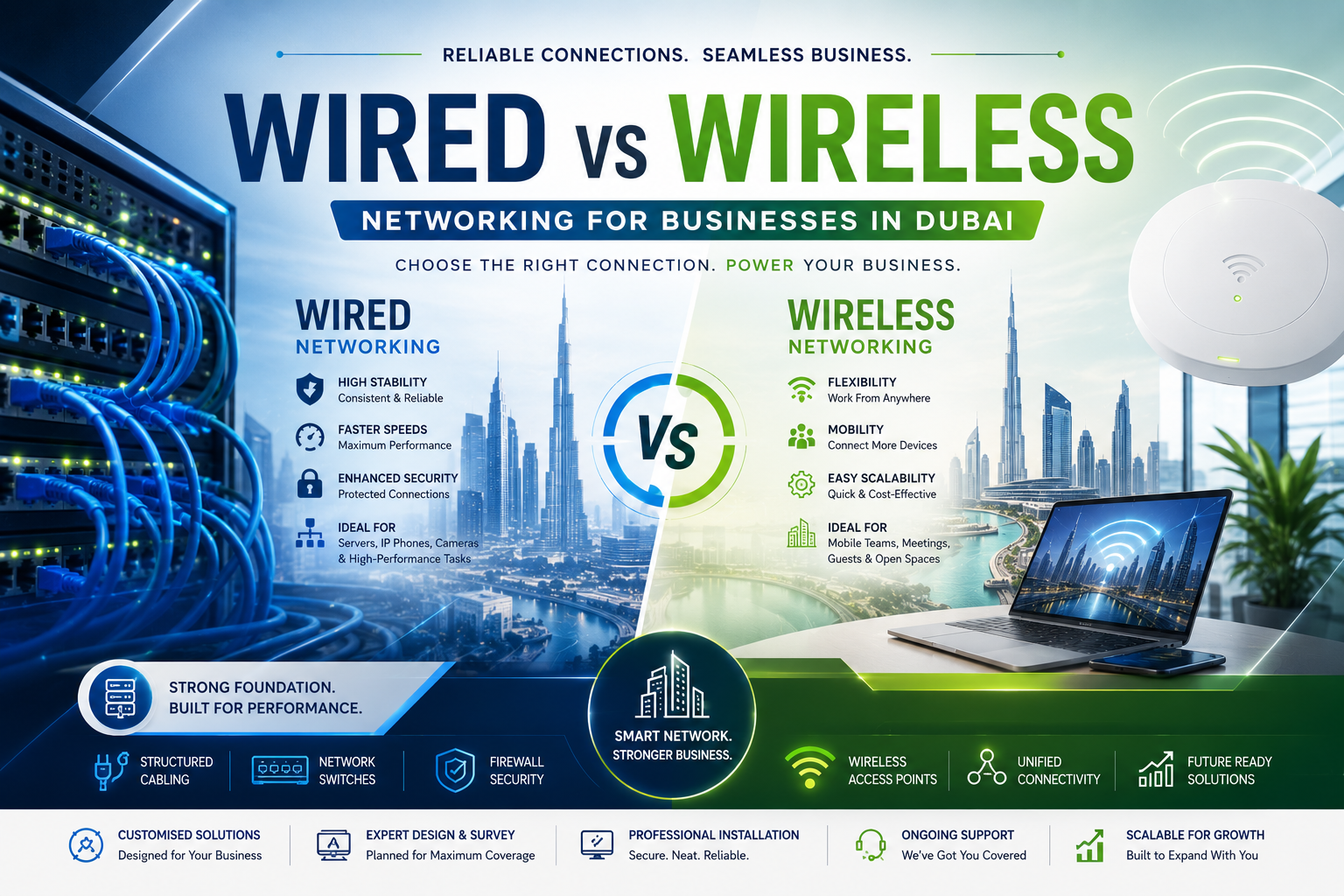
Wired vs Wireless Networking for Businesses in Dubai
Any network in the home or office needs to be reliable. Computers, cloud applications, IP phones, printers, cameras, and meeting-room equipment all require a stable connection. When choosing networking solutions in Dubai, businesses have three main options: wired, wireless, or a mixture of the two.
A small office with mobile workers will have different requirements to a warehouse, hotel, clinic, or enterprise. Understanding the differences between the two approaches can help Organizations choose the one that suits them best.
What Is a Wired Business Network?
Wired connections use Ethernet cabling, switches, and data outlets to connect computers, servers, IP phones, printers, access points, and cameras to the internet.
A wired connection is the best choice for a reliable link, particularly for stationary equipment. Whenever possible, switches and data outlets should be used to connect servers, workstations, storage, IP telephony, or cameras that use or generate large amounts of data. Power over Ethernet switches can also be used to connect IP phones, cameras, or access points.
However, once the switch or data point has been connected, it becomes necessary to connect end-user equipment to the available outlets. As a result, there is less flexibility in terms of moving equipment, and more data outlets are required as part of an office fit-out.
What Is a Wireless Business Network?
Hotspots and access points provide an option for Organizations to offer a wireless connection for laptops and mobile devices. These can provide much-needed flexibility for deskless workers, in meeting rooms, or in hospitality and logistics settings. However, a wireless connection needs to be carefully planned in terms of coverage and capacity.
According to networking solutions provider Cisco, wireless access points are essential for delivering Wi-Fi where and when it is needed and supporting users as they move from one location to another.
However, an Organization’s business-grade Wi-Fi should not be based on a single access point provided by a consumer-level router next to the internet connection.
Walls, glass partitions, shelves, or other networks should also be taken into account, together with the number of users who will connect to the same access point. A survey can help you understand how many access points your Organization needs to support its users.
Wired vs Wireless Business Networking: The Main Differences
Wired connections offer much greater reliability and stability than their wireless counterparts, particularly for stationary equipment. Fibre optics can carry huge amounts of information at great speeds, but switches and data points usually require more careful selection and management. By contrast, wireless access points offer much greater flexibility but need to be placed strategically and with the right transmission power in mind.
Both options can play a role within an enterprise. When comparing networking services Dubai providers offer, business owners need to carefully consider whether specific equipment could benefit from the stability and guaranteed bandwidth of a wired connection and whether their staff would benefit from the flexibility of a Wi-Fi access point.
When Should Your Business Select Wired Networking?
Businesses should consider using a wired connection to connect servers, storage, workstations, call-centre phones, printers, access control, and IP cameras. It is also a good choice for any enterprise that needs to transfer large files over a network or reduce the number of available data outlets for everyday users.
Wired connections are also a good option for enterprises that already have the cabling infrastructure in place or are preparing to undertake a major office fit-out. With the right number of data outlets and switches, Organizations can expand their network and connect additional equipment without the need for extra outlets. It is also essential for enterprises that want to separate users and equipment, such as phones and cameras, from general data.
When Is Wireless Networking the Better Option?
Hotspots and access points are an excellent solution for enterprises with mobile workers who rely on tablets and laptops. They can also be very useful in meeting rooms, hospitality settings, large venues, and warehouses. However, a wireless connection is never an end in itself: every access point requires a wired connection, power, configuration, and strategic placement.
When planning a wireless network, it is important to take into account the number of users and applications, as well as the impact on guest access, roaming, and range. Access points must also be placed strategically to ensure that they can reach corridors and reception areas.
Why the Hybrid Approach Is Usually Best
Most Organizations would benefit from a hybrid approach that uses both wired and wireless connections. Hybrid solutions offer the best of both worlds and allow businesses to operate more flexibly and reliably. The wired connection core can carry traffic with confidence, while access points can offer a simple way for guests and mobile workers to stay connected.
In addition, a hybrid approach can also make IT management easier by separating users, such as staff and visitors, and different applications, such as IP cameras or telephony. At the same time, enterprises can reduce the number of power supplies by using Power over Ethernet switches. Hybrid networks can also benefit from backup power supplies, structured cabling, and monitoring to maximise reliability.
Planning the Right Network for Your Business in Dubai
Before installing the network, it is essential to work with a provider to understand your requirements and expectations. The same hybrid solution will not be appropriate for both a warehouse and a high-rise office, while a connection using fibre and switches alone may not be sufficient for users who require Wi-Fi.
The provider should analyse the space, users, applications, internet connection, cabling, equipment, security, and future requirements. Whereas a warehouse will benefit from a strategic analysis of directional access points, a hotel will need to take into account the number of users in each space. By contrast, an office environment may have requirements in terms of video conferencing or IP telephony.
Enterprises looking for the best IT networking provider Dubai has to offer can ask whether the company provides a survey, advice, design, hardware, cabling, secure setup, testing, and documentation.
Plexus Priming It Trading & Security Installation can provide enterprises with wired, wireless, and hybrid networking solutions that allow Organizations to select the most appropriate technology for their requirements. The company can survey the working environment and advise on the right balance between structured cabling, network switches, routers, firewalls, and wireless access points.
Frequently Asked Questions
1. Is a wired network faster than Wi-Fi?
A wired connection is likely to be more consistent than a wireless connection, but it depends on the network hardware, switches, devices, wireless standard, and broadband connection.
2. Can a business operate on a Wi-Fi connection only?
It is possible, but most Organizations will benefit enormously from a hybrid approach that uses both wired and wireless connections. In most cases, enterprises will require wired connections to support access points, servers, applications, and equipment such as IP phones or cameras.
3. How many wireless access points does an office need?
It depends on the size of the office, the building’s construction, the number of users, and the applications they use. Surveying the office space is the best way to ensure that the number of access points is sufficient to cover the required area and support the required number of users.
4. Is wired networking more secure than wireless networking?
A wired connection is more difficult to access than an open wireless spot, but both can be made secure and isolated with the right switches, access points, setup, configuration, segmentation, encryption, and monitoring.
5. What should a business networking site survey include?
A networking site survey should include the office or building layout, existing cabling, equipment locations, connected devices, user numbers, wireless coverage, capacity, security requirements, power availability, and internet connection. It should also take future expansion into account so that the network can support additional users and equipment.